
Nice

It is the unforeseeable that creates the event. (Georges Braque)
I want to paint a picture of the Nice that I knew.
I was 21 years old, a student at U of T, and I paid my own way to take a summer session at the Centre international d’études françaises in Nice. I’d never travelled anywhere on my own before, much less overseas, so it was a daunting prospect.
I went to Nice a week or so early, to get my bearings before classes began. I’ll never forget the landing at Nice airport, skimming low over blue water and yachts before a runway suddenly materialized at seemingly the very last moment before we’d hit the sea.
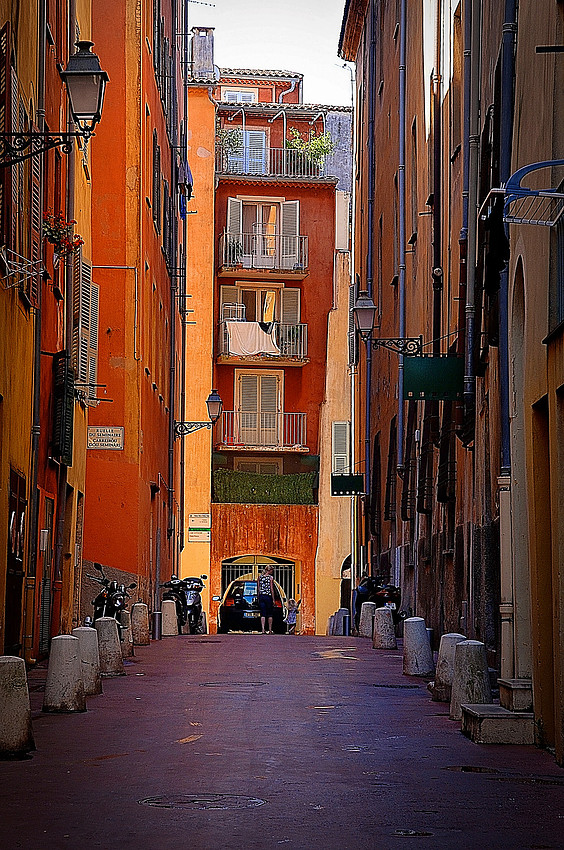
The city itself was a feast for the senses; I’d never experienced the aromas of an open-air market before, where purveyors of flowers, cheese, fruit, fish and fresh meat stood side by side, and shoppers picked and chose morsels to put into their filet shopping bags. The old part of the city was a maze of narrow streets snaking between hôtels particuliers, and the new commercial district boasted fashion names I’d seen in magazines. The people were the warmest and kindest I have ever met in France or for that matter anywhere else: from an older lady who stopped me in the street to gently remind me to zip up my tote bag (gare aux voleurs, ma fille!), to the shopkeeper next to my hotel who tentatively tried out his English by pointing at wares and asking how to pronounce them, to the crazy aubergiste who was running the hostel I ended up staying in. The city was a remarkable amalgam of working class and elegance; of French, Italian, African, Middle-Eastern, American sailors from the naval base in Villefranche, and tourists from all over the world.
Dragging my suitcase to the bus stop, en route to sign in at the University residence, I met up with another girl my age, also saddled with a suitcase, and headed to the same place I was going. This moment forged a friendship that has lasted more than three decades.
That summer at the university in Nice was probably the best in my life. My dorm room was in a building on a hill overlooking the azure-blue Mediterranean; at night, I watched planes come in for a landing at the airport; the lights of the queued aircraft looked like a string of sparkling jewels. Classes were held in the mornings: we learned about art and culture and all sorts of frivolous and fascinating things French. Afternoons, we were on our own to make our own fun (for those of us who hadn’t bypassed the morning classes altogether) and headed straight to the beach. At lunchtime, we lined up on the stairs to the cafeteria, waiting with our empty trays, and chatted with students from all over the world; English was the lingua franca: I remember a couple of guys from Africa worked endlessly at mastering the subtle distinction in pronouncing the aspirated ‘’h’’: ‘’I am angry’’/ ‘’I am (h)ungry’’. A guy from Denmark remarked about what a ‘’big clock’’ I was wearing on my wrist. Often, we took books and bamboo mats down to the stony beach, or we walked endlessly up and down the Promenade des Anglais, people-watching, smelling the roasting chestnuts being cooked up in large steel pans, or the savoury socca pancakes. We took the train to Monte Carlo, just 20 minutes away, or to Cannes, 20 minutes the other way. We spent Bastille Day crammed with the rest of France into a train headed for Ventimiglia, Italy. Another day, I dragged Anne and another girl up a mountain path to visit the village perché of Eze, hanging high above the Mediterranean. On weekends, the university would give us a shopping bag with a baguette, a boiled egg and some cheese, and we’d just find somewhere to sit and eat and chat. It’s not often that you recognize times of true happiness in the moment, but there were more than a few of those that summer. It was idyllic, and a lot of that was because of the environment that we were in: a warm, welcoming, honest city, unabashedly carefree but benevolently so. It did not have highbrow pretensions, like its neighbour Cannes, or Paris. It was a place where everybody could have fun, but somehow it managed not to broach the limits of safety or tawdriness. It was a good place to learn how to manage completely on my own, and I grew more as a person in those months than I have done at any one time in my life.
Several years ago, Tim and I were touring London and Paris. When our last day in Paris arrived, we headed to Orly airport; Tim thought we were headed home, and thankfully didn’t question why we weren’t going to Charles de Gaulle. When our flight to Nice was called, I explained to him that we were taking a short detour, so I could show him the place that I consider a second home. I dragged him through the Vieille Ville, up to the Château, down to the harbour, where luxury yachts bobbed side by side with fishermen’s dories. We had dinner in the Marché aux Fleurs. We took the train to Eze and to Monaco. Nice had changed, to be sure, in the intervening years; she’d prettied herself up and modernized, with a spiffy new tram running up Avenue Jean-Médecin, and some fancy facades on the seafront. But the aromas of chestnuts were still there, as were the leathery faces of the grand-mères at the market, the aromas of fresh fish, lavender and olives, and the exuberant atmosphere of fun in the sun. Despite the cosmetic changes, Nice held firm to her essence and her character. Whether she can heal from yesterday’s events is a question that makes my heart heavy.